|
UnExCo Home Picture Gallery <<< BACK < |

| Handling a Bald Faced Hornet Nest |

|
|
|
| The bald faced hornet - Dolichovespula maculata, (the new name) has been revised from Vespula maculata, and is actually a large yellow jacket, and not a true hornet. The only true hornet we have in the states is the European hornet, which, as you can imagine, came from Europe. |
|
I don't know why they worry about the name so much, I even had an entomologist email me with a correction
to the scientific name. Matter of fact, TWO people called me down on it.... "A rose by any other name
would smell as sweet." Whatever. In the trade, we just call 'em BFHs... |
|
Bald faced hornets make those large, almost round nests you can see in trees after the leaves have
fallen in winter. In the summer, nests are often hidden by vegetation. When winter comes, they will
abandon the nest from this year, usually by the first frost. They will build a completely new one, probably
somewhere else, next spring. The paper-like covering of the nest is made from chewed up wood, cardboard or paper that the workers will form into the outside nest covering. Hornet nests can also be quite colorful as the wasps will gather nest materials from different sources and different color woods. Nests are generally aerial, they will attach their nests to trees, bushes or sometimes even the side of a structure. Nests that are high in the trees should be left alone. They are definitely beneficial insects. Predatory, they kill other insects for us. |
|
However, if an active nest is well within your "personal" space and their flyway crosses your paths,
you may well want to do something about them. This nest, the one we detail below, was in a small ornamental pear tree, directly next to the front walkway of one of our regular customers. Quite naturally, she wanted these hornets GONE, so United took on the job! |
|
 |
|
 |
|
On this nest above, close to the ground and reachable, we opted to use our trusty bulb duster, loaded
with diazinon dust. A quick "poof" directly into the entrance hole was all it took. Immediately after
injecting the dust, we step aside, (QUICKLY!) and let the dust do it's work. Diazinon dust takes several
hours to work it's magic, so we leave and return the next day to remove the nest. Normally, it takes
less than an ounce of the dust to do the job. What happens if we miss? Not much, we just return the next night and try again. During "bee season," we can be out most nights. For the most part, we get these on the first shot. Do we use a special "bee suit?" Naaaah, that's only for pansies.... Being macho, we do it the old-fashioned way - quickly - without a bee suit. And, no, we're not crazy - sometimes those "bee suits" just get in the way, and since we've done so many over the years, we have good results doing it our way. |
|
 |
|
|
|
|
 |
|
 |
|
|
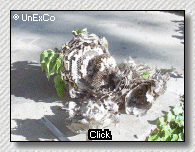
| (Click on the above picture to see the individual insects.) |
|
|
A bald faced hornet nest, (hornets are a social insect) could have anywhere from a hundred, to as many
as seven hundred (or even more) female workers, but there's only one queen at a time. The queen is the
mother of all the members of that single nest. There is only one queen to a nest, and she is the one
that starts the nest in the beginning, usually early in the spring. Most people don't notice the nests
until they get bigger and more noticeable. The inside of the nest consists of layers of cells, shaped kinda like a pie plate, with each layer slightly smaller than the previous layer, and with each of the cells containing a developing larva. The queen lays an egg in each cubicle, and the larvae (or grubs) will hatch within about two or three weeks (depending on food supply and temperature) to become worker hornets. The hornets will constantly make their nest bigger and bigger, to accommodate ever increasing combs and cells. You'll see them roam all over the nest, keeping everything in order and repairing any problem areas. They will tear down the old walls of the nest to create new ones. They can be very busy, and quite fascinating to watch. Hornets are predacious insects, which means they eat other insects. For this reason, they are beneficial insects and if they are up and out of the way, you might just as well leave them completely alone - they'll actually help you! The hornets also feed on ripe fruit, or even tree sap. These insects are always arround drops from fruit trees. Though mostly diurnal, they will also occasionally fly at night. They are attracted to lights, and you will always see them flying around outside lighting. The nest you see this year will only last the current season, and will be vacated after the first hard freeze or even a couple of mild frosts. After that, you can safely knock the nest down. If you can't, don't worry about it - it's very fragile and without the workers tending to it, it will usually disintegrate over the winter. |
|
|
Unlike bees, the poison of wasps and hornets is not really intended for use against us. Wasps and hornets
are mainly hunters of insects, while bees collect nectar, to make honey. With large amounts of honey
in an average honey bee nest, the main purpose of a bee sting is to defend the nest and the colony against
any attack, from mice and other animals, right up to humans. A honey bee loses the stinger mechanism
(and the poison sac) with a single sting. In fact, the poison sac will continue to pump venom even after
it is ripped from the bee, pumping even more venom after the bee is gone. Therefore, bee stings can often
cause a more severe reaction because of the amount of venom. Wasps (and hornets) can sting repeatedly but will pump much less venom with each sting than a bee will. However, because wasp venom is different than a honey bee's venom, a wasp sting can definitely be more painful. Wasps and hornets generally use their sting to kill their prey. Even though they will attempt to sting repeatedly, and although it is generally more painful, they do not inject their entire poison sac. For this reason, medically, humans usually have more to fear with the sting of the bee than the hornet. Science has discovered that the hornet sting contains acetylcholine, which is reported to stimulate pain nerves more than the stings of other wasps and bees. So the sting of a hornet can be a bit more painful. Got that? Personally, I find the sting of a paper wasp to be the worst for me. Other people might have a different reaction. When you are near a nest, rapid air movements, blocking flight paths, and jostling or breathing on the nests can initiate an attack by all of the colony immediately. Try not to let this happen.... |
|
| Cooling the area is soothing, the same as for bee stings. In exceptional cases, hornet stings, like any other insect stings, can induce an allergic reaction, some experts say this results from an overactive immune system. Considerable swelling and redness in the affected areas are sometimes the result. In the case of a reaction such as this, you should always see a doctor to be on the safe side. |
|
WHAT HAPPENS TO ME WHEN I GET STUNG I get stung all the time. I hate it too. Actually, the hornets are not too bad, unless they get you in a tender area, such as on your face. When they get me on the face, it does swell up enough for people to notice. It is uncomfortable too, and it stings for awhile - depending on how good of a hit they get on you. My last eye-hit, the swelling was obvious for a couple of days. The "sting" part goes away pretty quickly, although it will DEFINITELY bother you for the rest of the day. And they WILL aim for your eyes, BTW. If they hit you in other places it's not as bad, but getting stung anywhere is not my idea of fun. To me, the hornets, yellow jackets and paper wasps all have the same kind of sting; a sharp sting sensation, followed by swelling and itching, as days go by. It's a real pain, to coin a phrase.... Honeybee stings (again, for me) are not half that bad. And honeybees usually only sting when you really bother them, or in an actual defense of their nest. Follow these directions for a bee sting. Excellent advice from the University of Michigan Health System. |
|
|
Wanna try it yourself? Sure, no problem. First of all, best time to do it would be at night. When it's
COMPLETELY dark. Get all set up beforehand, know where the nest hole is, make sure you can reach right
up to it. Set up a ladder (if you need it) in the daytime, leave it there until zero hour when you'll
be doing it. That way the hornets will be used to its presence when you come out to do the deed and you
won't trip over your own equipment in the dark. Pick up some "wasp freeze" from your local hardware store, pick up the biggest and the cheapest, one that fits into your personal budget.. Might be a good idea to pick up at least TWO cans. Make sure you know how the can works. Practice with it, know how the fluid comes out, how strong it comes out and how it shoots, sometimes these cans come "short-filled," and you definitely don't want any surprises.... NIGHTTIME COMES.... At night, take your time to set yourself up to get the right shot. There will always be a few hornets on the nest set up as guards. It may help to have someone help you by holding a flashlight so you'll be able to see what you're doing. DO IT THIS WAY Shoot the entire outside of the nest, quickly, in a sort of circular motion, then move right in and get the spray right inside the hole. Give it a good 5 or 10 second shot. That should be plenty. And I know the directions on the can may sometimes say you can do this from 15 feet away, but don't believe it - best to get the spray DIRECTLY into the hole, or you run the risk of an invalid treatment and (perhaps) a slew of angry hornets. Depending on the type of can you buy, you can sometimes use a large-sized soda straw to make an extension to the can nozzle. Remember, all this can take practice, make sure you know exactly what you're going to do! After shooting the both hole and the nest, move away from the area IMMEDIATELY! Have your compatriot IMMEDIATELY turn off the light. Wasps (and hornets) will fly directly at lights, remember that, use the flashlight sparingly. WATCH OUT FOR THAT LADDER! Don't fall over it and get stung like happened to me one time. REMOVING THE NEST The next day, after observing that the nest has NO ACTIVITY, you can cut the nest down. Before you do it, shoot the nest AGAIN, right into that entrance hole, to take care of any hornets that spent the night out and returned, (there are always a few) or any new ones that have hatched out overnight and survived your first attack. Put the nest into a sealed plastic trash bag and dispose of the bag and contents. That's all there is to it. Good luck! (It really isn't that hard....) FINALLY... Don't try and keep a nest you have poisoned, there are a host of chemicals in there! Not only that, but the leftover hornets inside, and their larva, will begin to stink in a few days, it won't be suitable for keeping out in the open. |
|
|
Now, if you DON'T want to do it yourself, and you want United to do it for you - and that's definitely
understandable - we generally service the area on this map. Just give us a call or you can email us
from our contact page. Or you can fill out this form and we will reply by email, with a quotation tailored to your personal requirements. Please include your phone number (and times to call) if you wish us to call you. WHAT WE NEED TO KNOW TO QUOTE YOU A PRICE We will need to know the EXACT location of the nest on your property, how high off the ground it is, and if anyone has disturbed the nest, or attempted any kind of treatment, when that treatment was performed, and what was used. We will also need your address and phone number. |
|
|
For our bald faceed hornet treatments, that could possibly mean three separate visits. The price we
quote is what you pay.regardless of how many times we need to come out. Our first visit, will be to determine exactly where the nest is, mark the site with a flag and plan our procedure. This we do in the daytime. We will also look to see if we can find any more, so be sure and let us know if it's okay to walk around the outside of your house without disturbing dogs, fences or land mines. The second visit is when we will actually treat the nest, assuming we were unable to take care of it on our first visit. (There are sometimes, for whatever reason, our main treatment might have to be done at night.) Sometimes we can do everything in the daytime, depending on the situation. Our third visit, a day or two after a successful procedure, is to remove the nest, or destroy it so it can't be mistaken for an active nest. |
|
|
Then again, I still get goosebumps almost every time I do one of these jobs, even after all these years,
I understand why you might be nervous. So if I'm not near you, and you're thinking you should call a
Pro, see if any of the IPCO guys are near you. Just click on "IPCO Member List." Tell any of
them that "John from United" sent you, for excellent personal service. You can also check on my Good Guys Page for someone that might be near to you. |
| |||
|
